Design thinking workshops: innovate around real user needs
Designing a new service, rethinking an internal process, relaunching a stagnant offer… Design thinking is the method that lets your teams do all of this — by starting from real user needs, not the assumptions made in the meeting room.
The method
A human-centred approach to innovating on complex problems
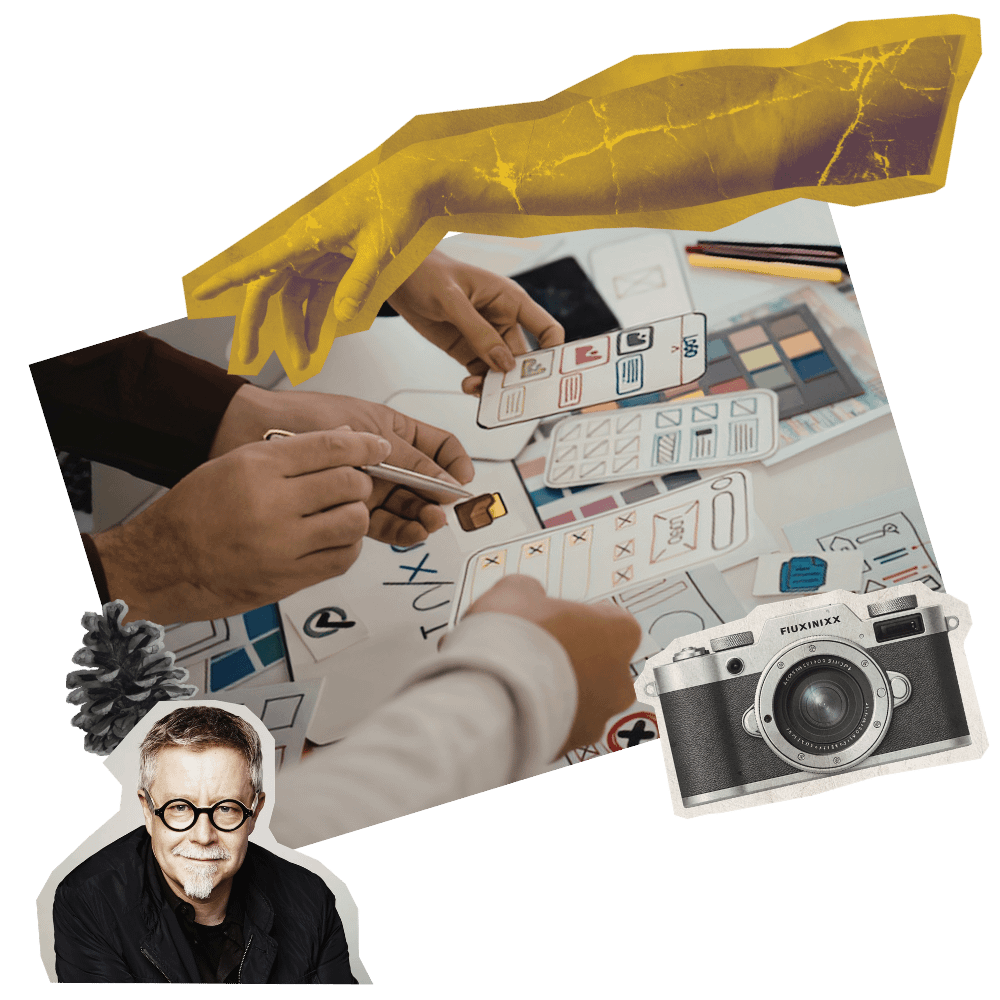
Popularised by Tim Brown (IDEO) and Stanford’s d.school, design thinking is a human-centred innovation approach: it starts from real user needs to design solutions that are desirable, feasible and economically viable.
Observe, understand, prototype, test — before committing to a final solution. The result: fewer risks and a solution reaching users faster. We use it as a core approach in our collaborative workshops focused on producing innovative solutions.
WHEN TO USE IT
Design thinking for strategic innovation — and well beyond
Applicable in any organisation, regardless of size or sector, design thinking is particularly effective when a problem is complex, poorly defined, or when conventional approaches have already reached their limits. We activate it in our innovation and creativity workshops, alone or combined with other methods.
→ Designing a new service offer centred on real customer needs
→ Rethinking an internal process that creates friction for team members
→ Relaunching a project stuck through lack of a shared understanding of the problem
→ Preparing a product launch by rapidly testing several concepts
→ Driving innovation in an R&D or marketing team stuck in its habitual patterns
→ Aligning diverse stakeholders around a shared strategic challenge

The process
From problem discovery to delivered solution:
4 iterative phases
Design thinking doesn’t follow a linear path. Each phase alternates divergence and convergence, and the process can loop several times based on user feedback. The goal: never invest in the wrong solution.
01.
Discover
Observe and understand before designing
Interviews, field observations, market analysis and unexpressed needs: we start from the users’ real problem, not the team’s assumptions. This empathy phase determines the relevance of everything that follows.
→ Questions become perceptions
02.
Design

Define the challenge and generate ideas
From the data collected, we reframe the real problem to solve, then generate as many ideas as possible without judgement. This is where Creative Problem Solving naturally connects with design thinking — structuring the ideation phase to produce genuinely new ideas.
→ Perceptions become ideas
03.
Develop
Make it tangible to test it fast
A prototype isn’t a finished product: it’s a rapid representation of an idea, tangible enough to gather real user feedback. Makestorming is PROPULSIO’s preferred tool for this phase, running in rapid iteration with the idea generation stage.
→ Ideas become prototypes
04.
Deliver
Test, refine and launch
The prototype is tested with real users. Feedback either feeds a new iteration or validates scaling up. This is where Lean Startup (agile approach) takes over: build, measure, learn — until you find the right market fit.
→ Prototypes become reality
Methodological combinations
Design thinking is even more powerful combined with other approaches
Design thinking is a framework, not a closed toolkit. At PROPULSIO, we combine it with other methods depending on the project’s challenges — to go further in ideation, agility or implementation.
Design thinking + Lean Startup
Design thinking frames problem discovery and solution design. Lean Startup then validates hypotheses rapidly against the real market: build-measure-learn cycles, MVP, short iterations.
The ideal combination for high-stakes product or offer launches.
Design thinking + Creative Problem Solving
CPS structures and enriches the ideation phase of design thinking: divergence techniques, challenge reframing, selection of the most promising ideas. For when your team needs to produce solutions that are genuinely new, not just variations on what already exists.
A design thinking workshop calibrated to your challenge
Every workshop is designed from your real challenge:
we select the phases and most appropriate tools, and build a flow
that guarantees a concrete deliverable (persona, prototype or action plan)
at every stage of the project.
Also explore
Other PROPULSIO facilitation methods
Agile project management
Scrum, Lean Startup, Kanban: running your projects in iterative mode.